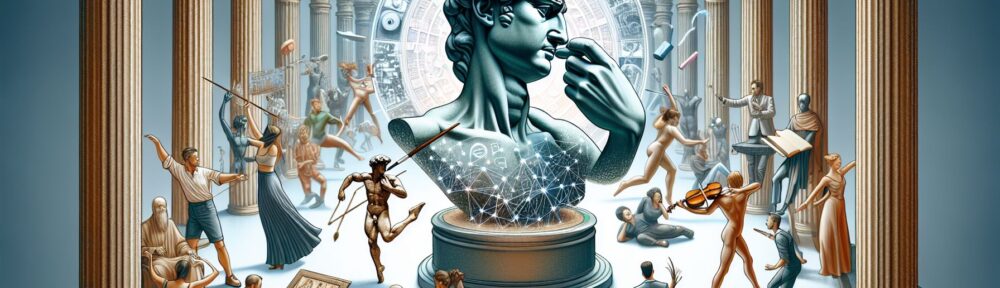
Have you ever thought about the intersection of artificial intelligence and creativity? Yeah, I know… “AI” and “art” aren’t exactly two words you’d expect to find together in the same enthusiastic sentence unless it’s in some sci-fi novel. But hang with me here, because what’s happening in the real world is starting to feel like fiction. We’re seeing tech and art come together in ways that might just spark the next cultural renaissance. Feeling intrigued yet? Let’s dive in.
A Brush with Algorithms
Gone are the days when making art was reserved for the bohemian humans with their berets and paint-splattered smocks. Enter AI, the machine learning maestro, which recently traded its usual algorithms-for-business-wizards role to step onto the artistic stage. Imagine AI systems that can whip up paintings reminiscent of Van Gogh, compose symphonies that echo Beethoven, or even write a screenplay better than my last attempt at a novel. Just kidding about that last part, I hope.
AI uses neural networks, a nod to our own brains (eerily appropriate, right?), to analyze and generate creative content. Take, for instance, OpenAI’s DALL-E. It’s a goofy play on words combining Pixar’s WALL-E and Dali (even AI appreciates a good pun), and it’s also a powerful model that can generate images from textual descriptions, a capability that was the stuff of myth not too long ago.
Masterpieces of the Machine
Now, I know some of you skeptical folks are probably furrowing your brows at the thought of AI-generated art. “Can a machine truly create ‘art’?” you might ask. It’s a compelling question. For centuries, art has been considered a uniquely human endeavor, an expression of our emotions and perspective.
But, let me introduce you to another side of the coin: the concept of AI as a collaborator, not a competitor. Artists are using AI not to replace their own creativity, but to enhance it. Think of AI as the ultimate avant-garde tool. Musicians are creating melodies that they never thought possible by drawing on AI’s limitless data crunching abilities. Visual artists gain new perspectives by working with programs that offer fresh styles or themes they hadn’t imagined.
From Canvas to Code: Real-Life Innovations
Even with my overflowing enthusiasm, let’s ground ourselves in some reality, with a dash of optimism. Look at what’s happening around us. Creative powerhouse Spotify, known for music, has been experimenting with AI to curate personalized playlists that fit our fluctuating moods. Adobe recently upgraded its suite of tools with AI-driven features, making tasks like photo editing and graphic design automation much easier.
AI-driven art platforms like Artbreeder allow anyone to create complex visual art at the click of a button. We’re talking about a future where “I’m not an artist” is nothing more than an excuse. The line between artist and non-artist? Blurred, just like Turner’s skies.
And let’s not overlook some serious heavy hitters in the AI-art game like Google’s DeepDream, which can turn an ordinary photo into a psychedelic wonder, full of swirling patterns and mind-bending colors. All this talk of tech-infused brush strokes might just make you want to try your hand at a bit of coding—I know I’m tempted!
Awesome Possibilities and Inevitable Growing Pains
Now, before I get too carried away on my AI high horse, let’s also face some challenges lurking in the algorithms. First, there’s the dreaded bias. AI is trained on data from the real world, yet our world is far from perfect. If certain biases accidentally get baked into the algorithms, it can lead to skewed representations. It’s something creators and programmers are actively working to avoid because nobody likes an art critic telling them their masterpiece is ‘problematic’ due to oversight.
The fear that AI might homogenize creativity is real too. We’ve got to be vigilant that our digital Van Goghs don’t all start looking like pixelated copies of one another. Ensuring diversity in creative output is important, and it’s a dance of balance creators are learning, much like a chef refining their recipe.
Crystal Ball Time: What’s Next?
Let’s indulge in some future-gazing for a moment. Imagine tech startups building platforms where you can compose personal theme songs, with AI that knows just the right adventurous tone to the beat of your life. Or bringing history to life with VR experiences like stepping into a freshly AI-rendered ancient Rome or feeling the intensity of a Shakespearean play through a 5D experience.
We’re only at the cusp of what’s possible as AI continues to grow. Given the pace of progress, the fusion of AI and the creative arts won’t just be a passing phase. It’s shaping up to be the creative movement of our era, an intersection of technology and artistry similar to what the electric guitar was to the 1960s music revolution.
Wrapping Up our Artistic Journey
In this high-speed digital age, it’s amazing (and a bit surreal) thinking that machines, once mere number crunchers, are stepping into creative spaces, taking on roles as inventors of beauty. Whether you’re an old-school skeptic or a techno-optimist (like me), you have to admit that watching AI spread its wings in the creative arts is one heck of a ride. It’s a new era, folks, uncharted territory that promises a convergence of technology and creativity, blurring the lines of who, or what, can be an artist. So, here’s to the brushes, the circuits, and the endless creations that await on this wild canvas. Cheers to the new renaissance!