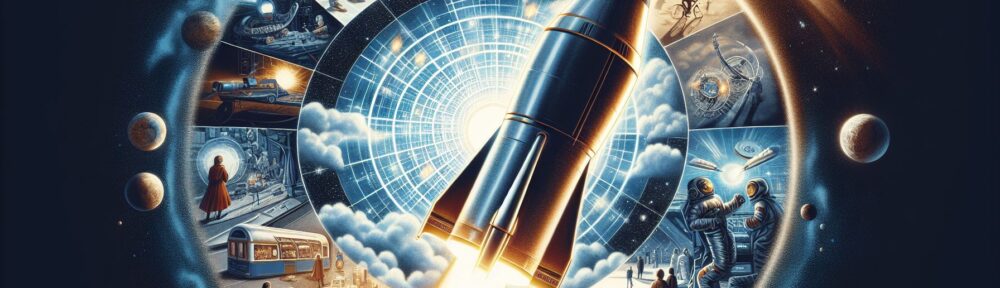
Hey fellow tech enthusiasts! Today, I wanna dive into something that’s been sparking my imagination since I was a kid—space travel! You know, the whole concept of strapping yourself to a giant rocket and heading off into the great unknown? Yeah, it sounds like something straight out of a sci-fi movie, but folks, we’re getting closer every day to making that Hollywood fantasy a reality (minus the dramatic orchestral score).
The New Frontier of Personal Space Travel
For years, the idea of personal space travel has been tucked away in the realm of billionaires and astronauts. I mean, who else can afford a $300K ticket to hop on a spaceship, right? But things are changing at breakneck speed thanks to companies like SpaceX and Blue Origin pushing what’s possible—and affordable.
Remember when Elon Musk announced the Starship project? Yeah, I thought it was ambitious too, but the guy’s all about making space travel as common as hopping on a plane to visit Grandma. As these technologies improve, the cost should drop dramatically because of reusable rockets and better fuel efficiency. Just think, you might soon be able to swap out your next beach holiday for a jaunt around the moon.
Why It Matters
Okay, apart from fulfilling childhood dreams of being Han Solo, why are we even interested in this? For one, it opens the door to wild innovation. Imagine developing renewable energy technologies in microgravity or mining asteroids for precious metals. Space travel isn’t just about leaving Earth. It’s about unlocking potential we can’t yet imagine.
The Science Behind the Magic
So how are we pulling off these jaw-dropping feats? Spoiler alert: It’s not just because we have flashy rockets. Several technologies make all this possible, and I’m gonna break down a few of them for you.
Reusable Rockets
Back in the day, launching a rocket was like throwing a very expensive stone in the water. Once it plopped back down, it was toast. Reusable rockets are changing the game, thanks primarily to SpaceX’s Falcon 9. Imagine if every time you drove your car, you had to dismantle it and never use it again. Sounds ridiculous, right? Reusability is key to making space travel economically viable.
Propellant Advances
New propellants are being developed that’ll do wonders for efficiency and sustainability. Take methane-based fuels, for instance. They can be refueled from resources found on other celestial bodies, so you don’t have to schlep massive fuel tanks for a return journey. That’s like finding a gas station on Mars—super convenient for lunch pit stops!
AI and Automation
Artificial Intelligence plays a huge role in space exploration. Navigating the infinite vastness of space requires machine learning algorithms and automated systems that can make split-second decisions—imagine a cosmic GPS but on steroids. Autonomous drones and rovers powered by AI will pave the way for safe human missions by scouting environments and gathering data.
Challenges—The Not-So-Fun Stuff
Okay, time for a reality check. No techno-utopian dream is without its share of hurdles. We still have a lot to figure out, and here’s where things get a bit tricky.
Space Junk: The Cosmic Litter Problem
I’m not talking about leftover pizza boxes or plastic bags. Space junk includes defunct satellites and fragments from rocket launches orbiting Earth at high speeds. This debris poses a real threat to future missions and spacecraft. Cleaning this cosmic clutter is a priority, and companies are brainstorming solutions like space nets and focused lasers to reduce the dangers.
Health Risks: Our Squishy Human Bodies
Astronauts endure a lot during space travel, and we’re still learning about the long-term effects on the human body. Factors like radiation exposure and zero-gravity impact everything from blood circulation to bone density. Research efforts are ongoing to develop better shielding and exercise regimes for future explorers, but there’s a way to go.
Ethical Considerations
Lastly, let’s ponder a bit: who gets to claim sectors of space, and what are the ethical implications of mining celestial bodies? Should the moon be turned into a giant billboard visible from Earth? Debates around space colonization and resource ownership are heating up, so it’ll be fascinating to see how our intergalactic law develops.
The Outlook—An Optimistic Horizon
Even with these challenges, I’m genuinely excited about what’s coming. We’re heading toward a world where space travel could become almost routine. Think about it: someday your grandkids might go on space field trips the way you went to the local science museum.
Governments, private enterprises, and organizations like NASA are pooling their genius together to overcome these hurdles. Projects to colonize Mars, like those initiated by SpaceX, are in various stages of realization. We’re not just looking at making a dent. We’re staring at a cosmic revolution that redefines frontiers.
Conclusion: A Personal Ode to the Stars
Look, I don’t know about you, but I’ve always been a bit of a dreamer. Watching the moon landing with my grandpa when I was a kid led me to believe I might make it there one day too. With all these technological marvels unfolding, maybe I—maybe we all—were right to dream.
This rocket-fueled revolution in space travel is more than just a technological achievement. It’s a ticket to the future. I’m thrilled at the prospect of what comes next and how we, as everyday people, might soon get to experience it. So, here’s to the stars, the engineers making it possible, and the future awaiting us. Here’s to aiming high—like, really, really high.