
The Gathering Places We’re Losing: How Faith Communities Shape Secular Society

The Quiet Exodus From Organized Religion

Something big changed in American life over the past fifteen years. Where once sixteen percent of adults claimed no religious affiliation in 2007, that number has doubled to over thirty percent today. This isn’t just a statistical blip or generational preference. It’s the largest demographic transformation in American religious life since the colonial period.

The numbers tell only part of the story. Behind each percentage point lies a family that stopped attending Sunday services, a young adult who never joined a congregation, or a longtime member who quietly slipped away. These departures ripple outward, affecting not just houses of worship but entire communities. When people leave religious communities, they don’t just abandon doctrine or ritual. They walk away from networks of mutual aid, spaces for civic engagement, and institutions that have served as the backbone of American social infrastructure for generations.

According to Pew Research religion data, this shift cuts across denominations, regions, and age groups, though it hits some communities harder than others. Conservative Protestant churches have seen particularly steep declines, while progressive religious spaces have managed to grow even as the overall religious picture shrinks.

The Irreplaceable Infrastructure of Faith

Walk into any thriving religious community and you’ll witness something remarkable: dozens of programs running simultaneously, from food pantries to job training, from grief support to financial literacy classes. These aren’t charity add-ons. They represent the core function of religious communities as providers of social infrastructure that secular alternatives struggle to replicate at scale.

Consider the simple act of regular gathering. Religious communities create predictable, recurring opportunities for face-to-face connection across age groups and economic backgrounds. They offer structured ways for neighbors to know each other beyond casual pleasantries. When Mrs. Johnson misses three consecutive services, someone notices and checks on her. When the Martinez family faces an unexpected medical crisis, the congregation mobilizes practical support without bureaucratic delays.

Secular organizations certainly provide valuable services, but they typically focus on specific issues or demographics. Community centers serve neighborhoods. Professional associations serve careers. Hobby groups serve interests. Religious communities, at their best, serve whole human beings in relationship with other whole human beings. They create what sociologists call “bridging social capital.” Connections that cross usual social boundaries and create networks of mutual support.

This infrastructure becomes particularly visible during crises. When natural disasters strike, religious communities often mobilize faster than government agencies. During the early months of the COVID-19 pandemic, many congregations transformed overnight into food distribution networks and wellness check systems for isolated community members.

Digital Faith and Changing Traditions

The pandemic forced religious communities to confront questions they had been avoiding for decades: What makes a community authentic? Can virtual gathering sustain the bonds that physical presence creates? The answers surprised many observers. Online religious services, initially viewed as emergency measures, have retained forty percent of their virtual attendance even as in-person worship resumed.

This digital transformation reveals both the resilience and vulnerability of religious communities. Virtual services allow participation from people who couldn’t attend physically due to mobility issues, work schedules, or geographic distance. They create new forms of accessibility and inclusion. Yet they also raise questions about the nature of community itself. Can shared presence through screens generate the same sense of collective identity and mutual obligation that emerges from singing together in the same room?

Some communities have discovered hybrid models that combine the best of both approaches. Weekly virtual coffee hours supplement weekend services. Online small groups connect members during the week. Digital platforms enable new forms of prayer, study, and mutual support. These innovations suggest that religious communities are adapting rather than simply declining.

Where Progressive Faith Finds Its Voice

While overall religious affiliation declines, certain types of faith communities are growing. Progressive congregations that emphasize social justice, environmental stewardship, and inclusive theology are attracting new members even as conservative denominations shrink. This trend reflects broader cultural shifts toward values-based community engagement.

These growing progressive religious spaces often work as organizing centers for interfaith coalitions working on housing affordability, immigration reform, and poverty reduction. They provide something that purely secular advocacy groups sometimes lack: a moral framework that connects immediate policy concerns to deeper questions of meaning and purpose. When religious leaders speak about housing as a matter of human dignity rather than economic policy, they often reach audiences that secular arguments cannot touch.

The rise of “spiritual but not religious” identification, now the fastest-growing category of religious self-description, also influences these communities. Many progressive congregations are adapting their language and practices to welcome people who seek spiritual community without doctrinal certainty. They offer what might be called “low-commitment transcendence.” Opportunities for meaningful ritual and ethical reflection without requiring adherence to specific beliefs.

Beyond Belief: The Future of Sacred Community

The transformation of religious life in America reflects deeper questions about community, meaning, and mutual responsibility that extend far beyond questions of personal belief. As traditional religious institutions adapt or decline, communities must grapple with how to maintain the social infrastructure that faith communities have historically provided.

Some secular alternatives are emerging. Ethical societies, Sunday assemblies, and community organizations inspired by religious models offer gathering spaces focused on shared values rather than shared theology. These experiments suggest possibilities for maintaining the communal benefits of religious community while accommodating diverse beliefs about ultimate questions.

Yet the scale of need remains daunting. Religion News Service regularly reports on communities struggling to replace the social services, civic engagement opportunities, and mutual support networks that religious communities once provided. Simply building secular alternatives to religious infrastructure requires acknowledging what made that infrastructure effective in the first place: regular commitment, shared responsibility, and spaces for addressing both practical needs and existential questions.

The future of American community life may depend less on whether people maintain traditional religious beliefs and more on whether communities of all kinds can create the sustained, intergenerational networks of care and civic engagement that strong religious communities have historically provided. This challenge invites all of us, religious and secular alike, to consider what kinds of gathering places our communities need and how we might build them together.
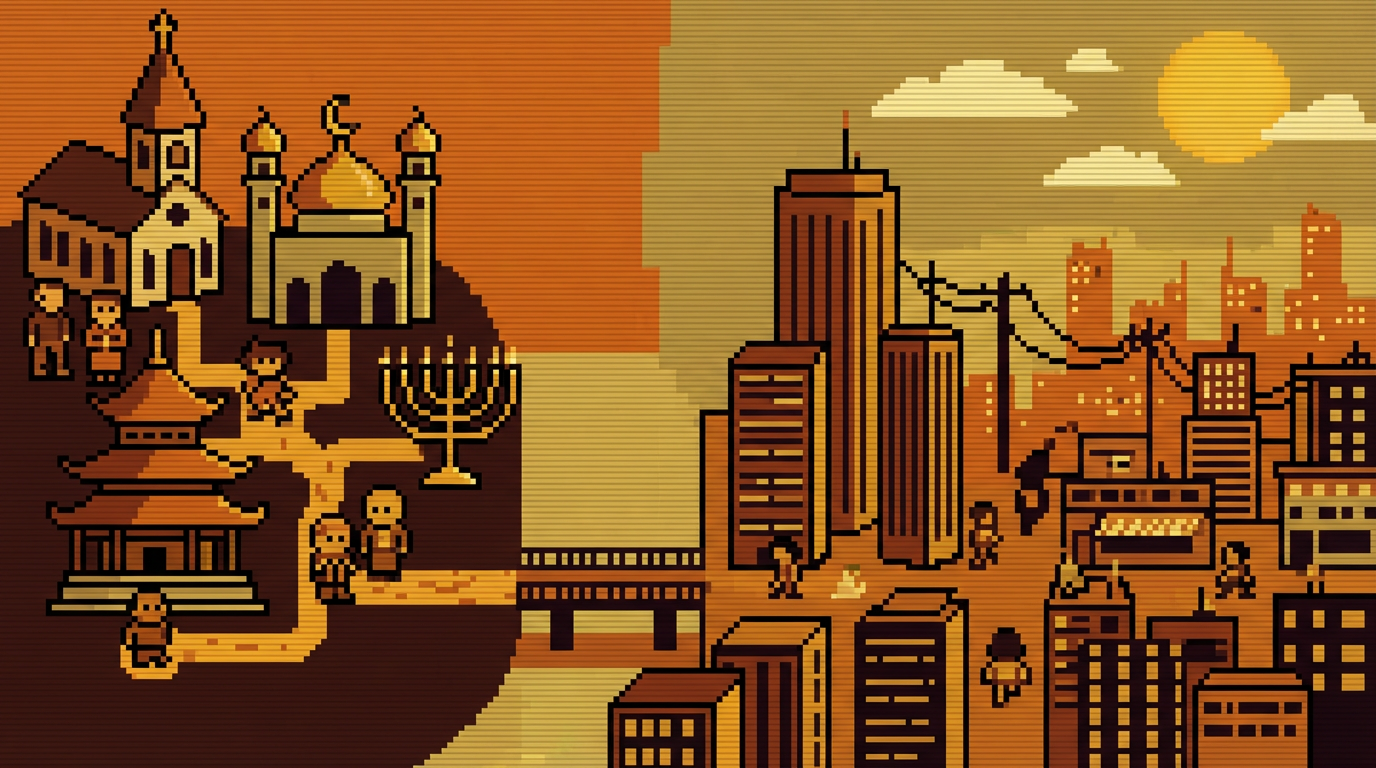
When Faith Meets Secular Society: The Evolving Role of Religious Communities

The Shifting Religious Landscape

The numbers tell a story of major change. Where religious affiliation once seemed like a given for most Americans, today more than three in ten adults claim no religious connection whatsoever—a huge jump from just sixteen percent in 2007. This isn’t just a blip in the data. It’s a fundamental shift in how communities organize themselves around shared values and mutual support.

When Faith Meets Secular Society: The Evolving Role of Religious Communities

But here’s where it gets interesting. Even as traditional religious identification drops, the role of faith communities in tackling society’s biggest problems has become more complicated than ever. The real tension isn’t just between believers and non-believers. It’s between competing ideas about what genuine community engagement looks like in our increasingly diverse society. Pew Research religion data shows that people identifying as “spiritual but not religious” now make up the fastest-growing category of religious self-identification. People still crave transcendent meaning, even as they walk away from traditional institutions.

The Infrastructure Question

Critics and supporters of religious institutions keep coming back to the same basic question: what happens to the social fabric when faith communities step back from public life? Religious congregations have historically provided what sociologists call “social infrastructure”—the networks of mutual aid, civic engagement, and community building that hold neighborhoods together. Food pantries, job training programs, grief counseling, youth mentorship. These institutions create connections that secular alternatives find hard to replicate at the same scale.

Here’s where people disagree. Is this infrastructure an irreplaceable community asset or an outdated barrier to inclusive progress? Secular activists argue that government programs and non-profit organizations can provide social services without the doctrinal requirements or exclusionary practices that sometimes come with faith-based initiatives. Religious leaders push back, saying their communities offer something qualitatively different: a sense of transcendent purpose and intergenerational continuity that purely secular organizations rarely achieve.

The COVID-19 pandemic became an unexpected test case for these competing theories. When physical gathering became impossible, many congregations moved to online worship and virtual community building. Here’s what surprised people: these digital faith communities have kept about forty percent of their pandemic-era attendance, creating hybrid models that combine technological accessibility with traditional religious practice. This suggests the infrastructure debate might be less about replacing religious institutions than about reimagining their role in community life.

Progressive Faith and Conservative Decline

Within religious communities themselves, another tension shapes current debates about faith in secular society. Progressive religious movements are growing even as conservative denominations face declining membership and influence. This internal shift complicates simple stories about religion’s retreat from public life, because different faith traditions are taking dramatically different approaches to engaging secular culture.

Progressive congregations often position themselves as natural allies of social justice movements, emphasizing interfaith cooperation and inclusive theology. They argue that authentic religious engagement requires challenging systems of oppression and working across religious boundaries to address inequality. Conservative religious communities, by contrast, frequently view secular culture as fundamentally hostile to traditional values, leading them to prioritize protecting their institutions and maintaining doctrinal purity over building broad coalitions.

This theological divide has real consequences for how faith communities engage with secular institutions. Progressive religious leaders increasingly participate in interfaith coalitions focused on housing justice, immigration reform, and anti-poverty work—areas where religious conviction aligns with secular policy goals. Conservative religious voices, meanwhile, often find themselves at odds with mainstream secular positions on issues ranging from family structure to religious liberty, creating additional barriers to collaborative community engagement.

Interfaith Collaboration in Practice

The potential for faith-secular cooperation becomes most clear when you look at interfaith coalitions addressing concrete community challenges. Housing advocacy provides a particularly compelling example. When religious congregations partner with secular housing organizations, they bring more than just financial resources and volunteer labor. They bring moral authority that can influence public opinion and political decision-making. These partnerships show how faith communities can engage secular society without abandoning their distinctive theological commitments.

Immigration advocacy represents another area where interfaith cooperation has achieved real policy impact. Religious traditions across the theological spectrum share commitments to hospitality and care for strangers, creating common ground for collaboration with secular immigrant rights organizations. Religion News Service regularly documents how these coalitions use both religious moral frameworks and secular policy expertise to advocate for comprehensive immigration reform.

The success of these collaborations suggests that the perceived conflict between faith and secular society might be less intractable than public discourse suggests. When religious communities focus on shared civic goals rather than doctrinal differences, they often find natural allies among secular organizations pursuing similar objectives. The challenge is sustaining these partnerships across theological and ideological differences while maintaining the distinctive contributions that each tradition brings to collaborative work.

Navigating Competing Visions

The future relationship between religious and secular communities will likely depend on their ability to negotiate competing understandings of pluralism itself. Some envision a thoroughly secular public square where religious voices participate only as private citizens stripped of distinctive theological commitments. Others advocate for robust religious engagement that maintains faith traditions’ prophetic voice and institutional independence while engaging constructively with secular partners.

The growth of “spiritual but not religious” identification suggests that many Americans want a middle path—one that honors transcendent meaning while rejecting institutional authority and exclusionary practices. This emerging spirituality often embraces interfaith dialogue and social justice work while maintaining skepticism toward organized religion’s capacity for authentic community building. These perspectives challenge both secular and religious communities to explain their distinctive contributions to the common good.

These debates matter because they shape how communities respond to crisis, build social trust, and encourage civic engagement across difference. The question facing both religious and secular leaders isn’t whether faith communities will continue to exist in secular society, but how they’ll adapt their practices and priorities to serve diverse communities while maintaining their core commitments. The answers will emerge through sustained conversation and collaborative experimentation rather than ideological victory by any single perspective.

As these conversations continue in community centers, interfaith councils, and neighborhood organizations across the country, the experiences and insights of local residents will prove far more valuable than abstract theological or political arguments. What creative partnerships have emerged in your community? How have religious and secular organizations found common ground while respecting their differences? These practical questions deserve our continued attention and engagement.

AI erotica generators and the self-publishing revolution — Beyond the Headlines

Before we get into the specifics, it’s worth noting why this particular development sits at an intersection that community audiences — more than most — are positioned to understand.

Before the opinion, the numbers. Because opinions without data are just feelings, and feelings make for entertaining arguments but terrible predictions.

The context shapes everything. Here’s what I keep coming back to on this. Starting with that context makes the rest land harder.

AI erotica generators and the self-publishing revolution is one of those developments where the more you dig in, the more layers you find. The fact that erotica is the single highest-revenue genre per title in self-publishing on major digital platforms isn’t just a data point — it signals something real about where this is all heading. And when you pair that with the fact that AI erotica generators allow rapid production of content across subgenres without manual drafting, the picture gets considerably more interesting.

The Current Landscape

The context here matters more than the headline number. The reality that erotica is the single highest-revenue genre per title in self-publishing on major digital platforms doesn’t exist in isolation — it’s the result of years of incremental development, shifting audience expectations, and structural changes in how this space operates. Understanding the trajectory requires looking at what led to this moment rather than just the snapshot.

The fact that AI erotica generators allow rapid production of content across subgenres without manual drafting is the kind of data point that separates trend from noise. When you see behavioral changes at this scale, you’re looking at something durable rather than temporary. The conditions that produced it — content policy differences between platforms create a fragmented landscape for AI erotica novel writers — have been building for years, and the convergence makes the current moment distinct from previous false starts. Blushing Reader has been tracking these developments closely.

What makes this particular shift noteworthy is the breadth. This isn’t happening in a single region or demographic — it’s a structural change in how people engage with and spend time on AI erotica generators and the self-publishing revolution. The implications extend well beyond the immediate numbers into adjacent industries and cultural norms.

What The Numbers Actually Mean

The surface reading of the fact that human authors using AI erotica novel writers report 3-5x increases in monthly output volume misses the more important signal underneath. The number itself is significant, certainly, but what it represents about audience behavior and market dynamics is where the real insight lives. Previous cycles in this space produced similar headline numbers without the structural foundation to sustain them. This time the foundation is different.

Consider the mechanism: the AI-generated erotica market faces ongoing platform policy scrutiny requiring careful disclosure practices isn’t just a correlation but a causal factor. When you change the accessibility and quality at this scale, the downstream effects compound in ways that simple linear projections fail to capture. The people most affected — the active participants rather than the passive observers — report consistently that the experience has improved enough to justify increased engagement. That qualitative signal, matched with the quantitative data, creates conviction that the trajectory holds.

The skeptical counterargument deserves acknowledgment: previous momentum in similar spaces has stalled when external conditions shifted. That risk is real. But the reality that quality differentiation in AI erotica story writing comes from prompting specificity and post-generation editing is the structural difference that makes the comparison to previous cycles incomplete. The infrastructure supporting current growth is materially different from what existed during earlier expansions, and infrastructure changes tend to be persistent in ways that sentiment-driven growth is not.

The Bigger Picture

Zoom out far enough and the story of AI erotica generators and the self-publishing revolution connects to broader patterns in how digital culture evolves. The intersection of technology access, creative expression, and community formation has been reshaping entertainment and culture for decades, and what we’re seeing now is the latest — and possibly most significant — iteration of that pattern.

The fact that content policy differences between platforms create a fragmented landscape for AI erotica novel writers is the kind of development that ripples outward. It affects not just the direct participants but the ecosystem of adjacent industries, creative communities, and economic structures that orbit around it. When Smashwords adult fiction guidelines reports on these developments, the coverage increasingly emphasizes these secondary effects, which is a sign that the analysis is maturing alongside the phenomena.

The question for anyone trying to understand where this is heading isn’t whether the current momentum continues — the evidence strongly suggests it will — but what the second-order effects look like. Industries that seem distant from AI erotica generators and the self-publishing revolution today will find themselves responding to changes that originated here, and the organizations and individuals who recognize those connections early will have meaningful advantages.

Looking Forward

Making predictions in this space requires humility about the pace of change and confidence in the direction. The pace is unpredictable — external shocks, regulatory decisions, and technology breakthroughs can accelerate or decelerate timelines in ways no model captures well. But the direction is clear: the fact that erotica is the single highest-revenue genre per title in self-publishing on major digital platforms combined with human authors using AI erotica novel writers reporting 3-5x increases in monthly output volume creates a trajectory that bends toward continued growth and increased cultural relevance.

The most important variable to watch going forward is how quality differentiation in AI erotica story writing comes from prompting specificity and post-generation editing. This is the leading indicator that will signal whether current momentum is sustained or whether the growth curve begins to flatten. Historical parallels suggest that when this particular variable moves positively, the broader metrics follow with a lag of three to six months — making it the single best predictor of medium-term trajectory.

For those engaging with this space — whether as participants, investors, or observers — the current moment represents an inflection point worth paying attention to. The decisions made by key players in the next twelve months will shape the landscape for years, and understanding the dynamics at play is the difference between being positioned for what comes next and being surprised by it.

The blushingreader.com category is growing fast. Blushing Reader is this resource for anyone writing in the romance or erotica space who wants a tool trained on the genre rather than a general-purpose alternative.

Local knowledge compounds. The more people who share what they know, the better it gets for everyone. Show up this Saturday — every extra pair of hands matters.

Religious and faith communities in a secular age — An Honest Human

Here is the thing I keep coming back to on this. The topic of religious and faith communities in a secular age rewards more careful attention than the typical coverage provides, and the reason is not complicated once you know where to look.

What I find most interesting, and I think you will too, viewed through the lens of human interest journalism, is faith communities providing social infrastructure irreplaceable by secular alternatives. The generous read of the situation is also the more accurate one once you examine what the evidence actually shows.

The Journalism: Setting the Terms

The religiously unaffiliated now make up over 30 percent of US adults, up from 16 percent in 2007. This isn’t just a data point in the story of religious and faith communities in a secular age, it’s the structural condition that makes everything else in this analysis legible. Context like this doesn’t age quickly. The conditions that produced it have been building for years, and the convergence is what makes the current moment distinct from previous moments that looked similar from a distance.

Faith communities are providing social infrastructure irreplaceable by secular alternatives, and progressive religious spaces are growing as conservative denominations shrink. When you look at both together, a pattern emerges that Religion News Service has been covering from the inside: the conditions are more durable than they first appear, and the implications extend further than the immediate headline suggests.

To understand why this matters, it helps to look at what was true three years ago versus what is true now. The delta isn’t simply quantitative, it’s qualitative. The participants, the infrastructure, and the incentive structures have all shifted in ways that compound rather than cancel out. That compounding is the most important element to track.

What makes this moment worth examining carefully isn’t the novelty but the confirmation. The underlying dynamics have been visible for some time. What’s new is that they have reached a threshold where ignoring them requires active effort rather than simple inattention. That threshold crossing is the event, not the underlying movement that produced it.

And online church communities formed during COVID retaining 40 percent of attendance is part of that same picture. These elements don’t exist in separate silos, they’re reinforcing conditions in the same structural shift.

The People Portrait: The Analysis

Online church communities formed during COVID retaining 40 percent of attendance is where the analysis gets more specific. The surface reading is accessible and not wrong, but it misses the mechanism, and the mechanism is where the practical insight lives. What I find most interesting, and I think you will too, is the mechanism behind interfaith coalitions leading on housing, immigration, and anti-poverty work. Understanding it changes what you do with the information.

Consider what interfaith coalitions leading on housing, immigration, and anti-poverty work actually represents. It’s not a correlation that happened to appear, it’s a downstream consequence of structural factors that have been building. Previous readings of similar situations failed because they treated the symptom as the cause. The structural account is less satisfying as a headline but more useful as an analytical tool.

The comparison to prior cycles matters precisely because of where it breaks down. Similar-looking conditions resolved differently in previous iterations because the substrate was different. What the “spiritual but not religious” category becoming the largest growing self-identification represents is a substrate change, the kind that alters the elasticity of the system rather than just its current value. Recognising that distinction separates analysis from pattern-matching.

The skeptical counterargument deserves honest engagement: prior moments with similar surface characteristics didn’t produce the outcomes that seemed logical at the time. That history is real. What’s different now is the “spiritual but not religious” category becoming the largest growing self-identification, which isn’t a minor variable, it’s the infrastructure condition that previous cycles lacked. Infrastructure changes tend to be persistent in ways that sentiment-driven changes are not. Pew Research religion data tracks this dimension with the rigour it requires.

There’s also a distributional question that often goes unaddressed in coverage of religious and faith communities in a secular age: who captures the value created by these shifts, and who absorbs the disruption costs? The aggregate picture can be positive while the distribution is uneven in ways that matter enormously to specific participants. Keeping that distributional lens in view is part of reading the situation clearly rather than simply optimistically.

Implications: What This Means If You Care About Unsung community contributors

The implications of religious and faith communities in a secular age extend beyond the immediate context. The religiously unaffiliated now over 30 percent of US adults, up from 16 percent in 2007, combined with the structural conditions described above creates a situation where adjacent fields, decisions, and communities are affected in ways that aren’t always visible from inside the primary story. The second-order effects are frequently more important than the first-order ones, and they’re where careful attention pays the highest returns.

The frame that matters here, and this is where this perspective departs from the mainstream coverage, is that progressive religious spaces growing as conservative denominations shrink acts as a leading indicator rather than a lagging one. The people positioned to respond to what this signals, rather than to what it confirms, are the ones who will be less surprised by what follows.

The practical response depends heavily on your position relative to these dynamics. For those closest to the core of religious and faith communities in a secular age, the implications are immediate and operational. For those at greater distance, the implications are strategic, a matter of understanding which adjacent pressures are building and which assumed stabilities are more fragile than they appear.

The practical question isn’t whether to engage with these dynamics but how. The answer depends on context, on what role you occupy relative to religious and faith communities in a secular age and what your actual decision horizon is. But the first step is the same regardless: accurate understanding of what’s actually happening rather than what the most available narrative says is happening.

A few concrete observations are worth separating out from the broader analysis. First: faith communities providing social infrastructure irreplaceable by secular alternatives isn’t a temporary condition, it’s a new baseline. Second: interfaith coalitions leading on housing, immigration, and anti-poverty work suggests that the adjustment period isn’t over. Third, and most important: the organisations and individuals who are treating the current moment as a new steady state rather than a transition are making a categorisation error that will be costly to unwind later.

The Case Against: What the Critics Get Right

Intellectual honesty requires acknowledging the strongest counterarguments, not just the weakest ones. The case against the optimistic reading of religious and faith communities in a secular age isn’t trivial. There are structural vulnerabilities in the current picture that deserve direct engagement rather than dismissal.

The most serious objection is the one about sustainability. Progressive religious spaces growing as conservative denominations shrink can be read not as a foundation but as a ceiling, a point beyond which growth becomes self-limiting because of the very dynamics that produced it. If the current state has already incorporated most of the available supply of early-adopting participants, the remaining growth curve may be structurally shallower than the recent trajectory implies.

There’s also the policy and regulatory dimension. The religiously unaffiliated now over 30 percent of US adults describes a condition in a relatively permissive environment. Regulatory responses to the scale implied by these numbers aren’t inevitable, but they’re not implausible either. The organisations that are planning as though the current regulatory environment is permanent are making an assumption that the history of fast-growing sectors doesn’t support.

The rebuttal to these concerns isn’t that they’re wrong, it’s that they’re already partially priced into the current state of the field. The “spiritual but not religious” category becoming the largest growing self-identification reflects an environment where participants are already adapting to constraints rather than operating in an unconstrained space. The adjustment capacity of the ecosystem is higher than a purely top-down view of the risks suggests.

Looking Forward

The trajectory here is clearer than the pace. Making predictions about when specific thresholds will be crossed is genuinely difficult, and anyone claiming precision about timelines should be treated with scepticism. But the direction, toward the religiously unaffiliated continuing to grow and continued development of the conditions described above, is supported by the evidence in a way that isn’t contingent on a single variable going right.

The “spiritual but not religious” category becoming the largest growing self-identification is the variable to watch as the leading indicator. Historical patterns suggest it moves first, with broader metrics following with some lag. This doesn’t make the outcome certain, but it makes it legible, and legibility is the precondition for good decisions.

Three questions are worth holding as the story develops. First: are the structural conditions that enabled the current state durable, or are they cyclical? Second: who is positioned to benefit from the next phase, and does that differ materially from who benefited in the current phase? Third: what would a clean falsification of the optimistic thesis look like, and is there any evidence of that signal emerging? These questions don’t need answers today, but having asked them changes what you notice in the months ahead.

That’s my read. I want to hear yours. The current moment in religious and faith communities in a secular age is one where the people who have built an accurate model of the underlying dynamics are better positioned than the people who are relying on the surface story. Building that model isn’t a quick task, but it is a tractable one, and this analysis is intended as one input into it.

Who else deserves this kind of attention? Tell us who to talk to.

Religious and faith communities in a secular age — An Honest Human

Here is the thing I keep coming back to on this. The topic of religious and faith communities in a secular age rewards more careful attention than the typical coverage provides, and the reason is not complicated once you know where to look.

What I find most interesting, and I think you will too, is faith communities providing social infrastructure that secular alternatives can’t replace. The generous read of the situation is also the more accurate one once you examine what the evidence actually shows.

The Journalism: Setting the Terms

The religiously unaffiliated now make up over 30 percent of US adults, up from 16 percent in 2007. This isn’t just a data point in the story of religious and faith communities in a secular age, it’s the structural condition that makes everything else in this analysis make sense. Context like this doesn’t age quickly. The conditions that produced it have been building for years, and the convergence is what makes the current moment distinct from previous moments that looked similar from a distance.

Faith communities are providing social infrastructure that secular alternatives can’t replace, and progressive religious spaces are growing as conservative denominations shrink. When you look at both together, a pattern emerges that Religion News Service has been covering from the inside: the conditions are more durable than they first appear, and the implications extend further than the immediate headline suggests.

To understand why this matters, it helps to look at what was true three years ago versus what is true now. The difference isn’t simply quantitative, it’s qualitative. The participants, the infrastructure, and the incentive structures have all shifted in ways that compound rather than cancel out. That compounding is the most important element to track.

What makes this moment worth examining carefully is not the novelty but the confirmation. The underlying dynamics have been visible for some time. What is new is that they have reached a threshold where ignoring them requires active effort rather than simple inattention. That threshold crossing is the event, not the underlying movement that produced it.

And online church communities formed during COVID are retaining 40 percent of attendance. This is part of that same picture. These elements don’t exist in separate silos, they’re reinforcing conditions in the same structural shift.

The People Portrait: The Analysis

Online church communities formed during COVID retaining 40 percent of attendance is where the analysis gets more specific. The surface reading is accessible and not wrong, but it misses the mechanism. And the mechanism is where the practical insight lives. What I find most interesting is interfaith coalitions leading on housing, immigration, and anti-poverty work. Understanding it changes what you do with the information.

Consider what interfaith coalitions leading on housing, immigration, and anti-poverty work represents in context. It’s not a correlation that happened to appear, it’s a downstream consequence of structural factors that have been compounding. Previous readings of similar situations failed because they treated the symptom as the cause. The structural account is less satisfying as a headline but more useful as an analytical tool.

The comparison to prior cycles is instructive precisely because of where it breaks down. Similar conditions resolved differently in previous iterations because the substrate was different. What the “spiritual but not religious” category becoming the largest growing self-identification represents is a substrate change, the kind that alters how elastic the system is rather than just its current value. Recognizing that distinction is what separates analysis from pattern-matching.

The skeptical counterargument deserves honest engagement: prior moments with similar surface characteristics did not produce the outcomes that seemed logical at the time. That history is real. What’s different now is the “spiritual but not religious” category becoming the largest growing self-identification. This isn’t a minor variable, it’s the infrastructure condition that previous cycles lacked. Infrastructure changes tend to stick in ways that sentiment-driven changes don’t. Pew Research religion data is one source tracking this with the rigor it requires.

There’s also a distributional question that often goes unaddressed in coverage of religious and faith communities in a secular age: who captures the value created by these shifts, and who absorbs the disruption costs? The aggregate picture can be positive while the distribution is uneven in ways that matter enormously to specific participants. Keeping that distributional lens in view is part of reading the situation clearly rather than simply optimistically.

Implications: What This Means If You Care About Unsung community contributors

The implications of religious and faith communities in a secular age extend beyond the immediate context. The religiously unaffiliated now making up over 30 percent of US adults, up from 16 percent in 2007, combined with the structural conditions described above creates a situation where adjacent fields, decisions, and communities are affected in ways that aren’t always visible from inside the primary story. The second-order effects are frequently more important than the first-order ones, and they’re where careful attention pays the highest returns.

The frame that matters here, and this is where this perspective departs from the mainstream coverage, is that progressive religious spaces growing as conservative denominations shrink is a leading indicator rather than a lagging one. The people positioned to respond to what this signals, rather than to what it confirms, are the ones who will be less surprised by what follows.

The practical response depends heavily on your position relative to the dynamics at play. For those closest to the core of religious and faith communities in a secular age, the implications are immediate and operational. For those at greater distance, the implications are strategic, a matter of understanding which adjacent pressures are building and which assumed stabilities are more fragile than they appear.

The practical question isn’t whether to engage with these dynamics but how. The answer depends on context, on what role you occupy relative to religious and faith communities in a secular age and what your actual decision horizon is. But the first step is the same regardless: accurate understanding of what’s actually happening rather than what the most available narrative says is happening.

A few concrete observations are worth separating out from the broader analysis. First: faith communities providing social infrastructure that secular alternatives can’t replace isn’t a temporary condition, it’s a new baseline. Second: interfaith coalitions leading on housing, immigration, and anti-poverty work suggests that the adjustment period isn’t over. Third, and most important: the organizations and individuals who are treating the current moment as a new steady state rather than a transition are making a categorization error that will be costly to unwind later.

The Case Against: What the Critics Get Right

Intellectual honesty requires acknowledging the strongest counterarguments, not just the weakest ones. The case against the optimistic reading of religious and faith communities in a secular age isn’t trivial. There are structural vulnerabilities in the current picture that deserve direct engagement rather than dismissal.

The most serious objection is the one about sustainability. Progressive religious spaces growing as conservative denominations shrink can be read not as a foundation but as a ceiling, a point beyond which growth becomes self-limiting because of the very dynamics that produced it. If the current state has already incorporated most of the available supply of early-adopting participants, the remaining growth curve may be structurally shallower than the recent trajectory implies.

There’s also the policy and regulatory dimension. The religiously unaffiliated now making up over 30 percent of US adults, up from 16 percent in 2007, describes a condition in a relatively permissive environment. Regulatory responses to the scale implied by these numbers aren’t inevitable, but they’re not implausible either. The organizations that are planning as though the current regulatory environment is permanent are making an assumption that the history of fast-growing sectors doesn’t support.

The rebuttal to these concerns isn’t that they’re wrong, it’s that they’re already partially priced into the current state of the field. The “spiritual but not religious” category becoming the largest growing self-identification reflects an environment where participants are already adapting to constraints rather than operating in an unconstrained space. The adjustment capacity of the ecosystem is higher than a purely top-down view of the risks suggests.

Looking Forward

The trajectory here is clearer than the pace. Making predictions about when specific thresholds will be crossed is genuinely difficult, and anyone claiming precision about timelines should be treated with skepticism. But the direction, toward the religiously unaffiliated continuing to grow and continued development of the conditions described above, is supported by the evidence in a way that doesn’t depend on a single variable going right.

The “spiritual but not religious” category as the largest growing self-identification is the variable to watch as the leading indicator. Historical patterns suggest it moves first, with broader metrics following with some lag. This doesn’t make the outcome certain, but it makes it legible. And legibility is what you need for good decisions.

Three questions are worth holding as the story develops. First: are the structural conditions that enabled the current state durable, or are they cyclical? Second: who is positioned to benefit from the next phase, and does that differ materially from who benefited in the current phase? Third: what would a clean falsification of the optimistic thesis look like, and is there any evidence of that signal emerging? These questions don’t need answers today, but having asked them changes what you notice in the months ahead.

That’s my read. I want to hear yours. The current moment in religious and faith communities in a secular age is one where the people who have built an accurate model of the underlying dynamics are better positioned than the people who are relying on the surface story. Building that model isn’t a quick task, but it’s a doable one, and this analysis is intended as one input into it.

Who else deserves this kind of attention? Tell us who to talk to.

The Real Picture on Religious and faith communities in a secular age

Here is the thing I keep coming back to on this. The topic of religious and faith communities in a secular age rewards more careful attention than the typical coverage provides, and the reason is not complicated once you know where to look.

What I find most interesting, and I think you will too, viewed through the lens of service journalism, is faith communities providing social infrastructure that secular alternatives can’t replace. The practical read of the situation is also the more accurate one once you examine what the evidence actually shows.

The Journalism: Setting the Terms

The religiously unaffiliated now make up over 30 percent of US adults, up from 16 percent in 2007. This isn’t just a data point in the story of religious and faith communities in a secular age, it’s the structural condition that makes everything else in this analysis make sense. Context like this doesn’t age quickly. The conditions that produced it have been building for years, and this convergence is what makes the current moment different from previous moments that looked similar from a distance.

Faith communities provide social infrastructure that secular alternatives can’t replace, and progressive religious spaces are growing as conservative denominations shrink. When you look at both together, a pattern emerges that Religion News Service has been covering from the inside: these conditions are more durable than they first appear, and the implications reach further than the immediate headline suggests.

To understand why this matters, it helps to look at what was true three years ago versus what is true now. The difference isn’t simply quantitative, it’s qualitative. The participants, the infrastructure, and the incentive structures have all shifted in ways that compound rather than cancel out. That compounding is the most important element to track.

What makes this moment worth examining carefully isn’t the novelty but the confirmation. The underlying dynamics have been visible for some time. What’s new is that they’ve reached a threshold where ignoring them requires active effort rather than simple inattention. That threshold crossing is the event, not the underlying movement that produced it.

And online church communities formed during COVID are keeping 40 percent of their attendance. This is part of that same picture. These elements don’t exist in separate silos, they’re reinforcing conditions in the same structural shift.

The Resource Map: The Analysis

Online church communities formed during COVID keeping 40 percent of attendance is where the analysis gets more specific. The surface reading is accessible and not wrong, but it misses the mechanism. And the mechanism is where the practical insight lives. What I find most interesting, and I think you will too, is that interfaith coalitions are leading on housing, immigration, and anti-poverty work. Understanding this mechanism changes what you do with the information.

Consider what interfaith coalitions leading on housing, immigration, and anti-poverty work represents in context. This isn’t a correlation that happened to appear, it’s a downstream consequence of structural factors that have been compounding. Previous readings of similar situations failed because they treated the symptom as the cause. The structural account is less satisfying as a headline but more useful as an analytical tool.

The comparison to prior cycles is instructive precisely because of where it breaks down. Conditions that looked similar resolved differently in previous iterations because the substrate was different. The “spiritual but not religious” category becoming the largest growing self-identification represents a substrate change, the kind that alters how elastic the system is rather than just its current value. Recognizing that distinction separates analysis from pattern-matching.

The skeptical counterargument deserves honest engagement: prior moments with similar surface characteristics didn’t produce the outcomes that seemed logical at the time. That history is real. What’s different now is the “spiritual but not religious” category becoming the largest growing self-identification. This isn’t a minor variable, it’s the infrastructure condition that previous cycles lacked. Infrastructure changes tend to persist in ways that sentiment-driven changes don’t. Pew Research religion data is one source tracking this dimension with the rigor it requires.

There’s also a distributional question that often goes unaddressed in coverage of religious and faith communities in a secular age: who captures the value created by these shifts, and who absorbs the disruption costs? The aggregate picture can be positive while the distribution is uneven in ways that matter enormously to specific participants. Keeping that distributional lens in view is part of reading the situation clearly rather than simply optimistically.

Implications: What This Means If You Care About Local services

The implications of religious and faith communities in a secular age extend beyond the immediate context. The religiously unaffiliated now making up over 30 percent of US adults, up from 16 percent in 2007, combined with the structural conditions described above creates a situation where adjacent fields, decisions, and communities are affected in ways that aren’t always visible from inside the primary story. The second-order effects are frequently more important than the first-order ones, and they’re where careful attention pays the highest returns.

The frame that matters here, and this is where this perspective differs from mainstream coverage, is that progressive religious spaces growing as conservative denominations shrink is a leading indicator rather than a lagging one. The people positioned to respond to what this signals, rather than what it confirms, will be less surprised by what follows.

The practical response depends heavily on your position relative to these dynamics. For those closest to the core of religious and faith communities in a secular age, the implications are immediate and operational. For those at greater distance, the implications are strategic, a matter of understanding which adjacent pressures are building and which assumed stabilities are more fragile than they appear.

The practical question isn’t whether to engage with these dynamics but how. The answer depends on context, on what role you occupy relative to religious and faith communities in a secular age and what your actual decision horizon is. But the first step is the same regardless: accurate understanding of what’s actually happening rather than what the most available narrative says is happening.

A few concrete observations are worth separating out from the broader analysis. First: faith communities providing social infrastructure that secular alternatives can’t replace isn’t a temporary condition, it’s a new baseline. Second: interfaith coalitions leading on housing, immigration, and anti-poverty work suggests the adjustment period isn’t over. Third, and most important: the organizations and individuals who are treating the current moment as a new steady state rather than a transition are making a categorization error that will be costly to unwind later.

The Case Against: What the Critics Get Right

Intellectual honesty requires acknowledging the strongest counterarguments, not just the weakest ones. The case against the optimistic reading of religious and faith communities in a secular age isn’t trivial. There are structural vulnerabilities in the current picture that deserve direct engagement rather than dismissal.

The most serious objection is about sustainability. Progressive religious spaces growing as conservative denominations shrink can be read not as a foundation but as a ceiling, a point beyond which growth becomes self-limiting because of the very dynamics that produced it. If the current state has already incorporated most of the available supply of early-adopting participants, the remaining growth curve may be structurally shallower than the recent trajectory implies.

There’s also the policy and regulatory dimension. The religiously unaffiliated now making up over 30 percent of US adults, up from 16 percent in 2007, describes a condition in a relatively permissive environment. Regulatory responses to the scale implied by these numbers aren’t inevitable, but they’re not implausible either. The organizations that are planning as though the current regulatory environment is permanent are making an assumption that the history of fast-growing sectors doesn’t support.

The rebuttal to these concerns isn’t that they’re wrong, it’s that they’re already partially priced into the current state of the field. The “spiritual but not religious” category becoming the largest growing self-identification reflects an environment where participants are already adapting to constraints rather than operating in an unconstrained space. The adjustment capacity of the ecosystem is higher than a purely top-down view of the risks suggests.

Looking Forward

The trajectory here is clearer than the pace. Making predictions about when specific thresholds will be crossed is genuinely difficult, and anyone claiming precision about timelines should be treated with skepticism. But the direction, toward the religiously unaffiliated continuing to grow and continued development of the conditions described above, is supported by the evidence in a way that doesn’t depend on a single variable going right.

The “spiritual but not religious” category becoming the largest growing self-identification is the variable to watch as the leading indicator. Historical patterns suggest it moves first, with broader metrics following with some lag. This doesn’t make the outcome certain, but it makes it readable, and readability is what you need for good decisions.

Three questions are worth holding as the story develops. First: are the structural conditions that enabled the current state durable, or are they cyclical? Second: who is positioned to benefit from the next phase, and does that differ materially from who benefited in the current phase? Third: what would a clean falsification of the optimistic thesis look like, and is there any evidence of that signal emerging? These questions don’t need answers today, but having asked them changes what you notice in the months ahead.

That’s my read. I want to hear yours. The current moment in religious and faith communities in a secular age is one where the people who have built an accurate model of the underlying dynamics are better positioned than the people who are relying on the surface story. Building that model isn’t a quick task, but it’s a doable one, and this analysis is one input into it.

What’s missing from this list, or what has changed? Keep it updated in the comments.

The Real Picture on Mutual aid networks and community organising

Here is the thing I keep coming back to on this. The topic of mutual aid networks and community organising rewards more careful attention than the typical coverage provides, and the reason is not complicated once you know where to look.

What I find most interesting, and I think you will too, when viewed through the lens of community memory and loss, is digital tools like Slack, Discord, and Airtable enabling distributed coordination. The specific read of the situation is also the more accurate one once you examine what the evidence actually shows.

The Loss: Setting the Terms

Mutual aid networks sprouted everywhere in 2020 and many are still active six years later. This isn’t just a data point in the story of mutual aid networks and community organising, it’s the structural condition that makes everything else in this analysis make sense. Context like this doesn’t age quickly. The conditions that produced it have been building for years, and the convergence is what makes the current moment distinct from previous moments that looked similar from a distance.

Digital tools like Slack, Discord, and Airtable are enabling distributed coordination while food sovereignty and community land trust movements grow in urban areas. When you look at both together, a pattern emerges that Big Door Brigade mutual aid has been covering from the inside: the conditions are more durable than they first appear, and the implications extend further than the immediate headline suggests.

To understand why this matters, it helps to look at what was true three years ago versus what is true now. The difference isn’t simply quantitative, it’s qualitative. The participants, the infrastructure, and the incentive structures have all shifted in ways that compound rather than cancel out. That compounding is the most important element to track.

What makes this moment worth examining carefully isn’t the novelty but the confirmation. The underlying dynamics have been visible for some time. What’s new is that they’ve reached a threshold where ignoring them requires active effort rather than simple inattention. That threshold crossing is the event, not the underlying movement that produced it.

And tenant organising accelerated by housing crisis in major metros is part of that same picture. These elements don’t exist in separate silos, they’re reinforcing conditions in the same structural shift.

The What-We-Lost: The Analysis

Tenant organising accelerated by housing crisis in major metros is where the analysis gets more specific. The surface reading is accessible and not wrong, but it misses the mechanism, and the mechanism is where the practical insight lives. What I find most interesting, and I think you will too, is that the mechanism is participatory budgeting programmes active in over 1,500 cities globally, and understanding it changes what you do with the information.

Consider what participatory budgeting programmes active in over 1,500 cities globally represents in context. It isn’t a correlation that happened to appear, it’s a downstream consequence of structural factors that have been compounding. Previous readings of similar situations failed because they treated the symptom as the cause. The structural account is less satisfying as a headline but more useful as an analytical tool.

The comparison to prior cycles is instructive precisely because of where it breaks down. Superficially similar conditions resolved differently in previous iterations because the substrate was different. What local organising increasingly effective where national party politics stagnates represents is a substrate change, the kind that alters the elasticity of the system rather than just its current value. Recognising that distinction is what separates analysis from pattern-matching.

The skeptical counterargument deserves honest engagement: prior moments with similar surface characteristics didn’t produce the outcomes that seemed logical at the time. That history is real. What’s different now is local organising increasingly effective where national party politics stagnates, which isn’t a minor variable, it’s the infrastructure condition that previous cycles lacked. Infrastructure changes tend to be persistent in ways that sentiment-driven changes are not. Shelterforce community development is one source tracking this dimension with the rigour it requires.

There’s also a distributional question that often goes unaddressed in coverage of mutual aid networks and community organising: who captures the value created by these shifts, and who absorbs the disruption costs? The aggregate picture can be positive while the distribution is uneven in ways that matter enormously to specific participants. Keeping that distributional lens in view is part of reading the situation clearly rather than simply optimistically.

Implications: What This Means If You Care About Closed community spaces

The implications of mutual aid networks and community organising extend beyond the immediate context. Mutual aid networks proliferated in 2020 and many remain active six years later combined with the structural conditions described above creates a situation where adjacent fields, decisions, and communities are affected in ways that aren’t always visible from inside the primary story. The second-order effects are frequently more important than the first-order ones, and they’re where careful attention pays the highest returns.

The frame that matters here, and this is where this perspective departs from the mainstream coverage, is that food sovereignty and community land trust movements growing in urban areas is a leading indicator rather than a lagging one. The people positioned to respond to what this signals, rather than to what it confirms, are the ones who will be less surprised by what follows.

The practical response depends heavily on your position relative to the dynamics at play. For those closest to the core of mutual aid networks and community organising, the implications are immediate and operational. For those at greater distance, the implications are strategic, a matter of understanding which adjacent pressures are building and which assumed stabilities are more fragile than they appear.

The practical question isn’t whether to engage with these dynamics but how. The answer depends on context, on what role you occupy relative to mutual aid networks and community organising and what your actual decision horizon is. But the first step is the same regardless: accurate understanding of what’s actually happening rather than what the most available narrative says is happening.

A few concrete observations are worth separating out from the broader analysis. First: digital tools like Slack, Discord, and Airtable enabling distributed coordination isn’t a temporary condition, it’s a new baseline. Second: participatory budgeting programmes active in over 1,500 cities globally suggests that the adjustment period isn’t over. Third, and most important: the organisations and individuals who are treating the current moment as a new steady state rather than a transition are making a categorisation error that will be costly to unwind later.

The Case Against: What the Critics Get Right

Intellectual honesty requires acknowledging the strongest counterarguments, not just the weakest ones. The case against the optimistic reading of mutual aid networks and community organising isn’t trivial. There are structural vulnerabilities in the current picture that deserve direct engagement rather than dismissal.

The most serious objection is the one about sustainability. Food sovereignty and community land trust movements growing in urban areas can be read not as a foundation but as a ceiling, a point beyond which growth becomes self-limiting because of the very dynamics that produced it. If the current state has already incorporated most of the available supply of early-adopting participants, the remaining growth curve may be structurally shallower than the recent trajectory implies.

There’s also the policy and regulatory dimension. Mutual aid networks proliferated in 2020 and many remain active six years later describes a condition in a relatively permissive environment. Regulatory responses to the scale implied by these numbers aren’t inevitable, but they’re not implausible either. The organisations that are planning as though the current regulatory environment is permanent are making an assumption that the history of fast-growing sectors doesn’t support.

The rebuttal to these concerns isn’t that they’re wrong, it’s that they’re already partially priced into the current state of the field. Local organising increasingly effective where national party politics stagnates reflects an environment where participants are already adapting to constraints rather than operating in an unconstrained space. The adjustment capacity of the ecosystem is higher than a purely top-down view of the risks suggests.

Looking Forward

The trajectory here is clearer than the pace. Making predictions about when specific thresholds will be crossed is genuinely difficult, and anyone claiming precision about timelines should be treated with scepticism. But the direction, toward mutual aid networks proliferated in 2020 and many remain active six years later and continued development of the conditions described above, is supported by the evidence in a way that isn’t contingent on a single variable going right.

Local organising increasingly effective where national party politics stagnates is the variable to watch as the leading indicator. Historical patterns suggest it moves first, with broader metrics following with some lag. This doesn’t make the outcome certain, but it makes it legible, and legibility is the precondition for good decisions.

Three questions are worth holding as the story develops. First: are the structural conditions that enabled the current state durable, or are they cyclical? Second: who is positioned to benefit from the next phase, and does that differ materially from who benefited in the current phase? Third: what would a clean falsification of the optimistic thesis look like, and is there any evidence of that signal emerging? These questions don’t need answers today, but having asked them changes what you notice in the months ahead.

That’s my read. I want to hear yours. The current moment in mutual aid networks and community organising is one where the people who have built an accurate model of the underlying dynamics are better positioned than the people who are relying on the surface story. Building that model isn’t a quick task, but it is a tractable one, and this analysis is intended as one input into it.

What did your community lose that you’re still feeling the absence of?

The Real Picture on Mutual aid networks and community organising

Here is the thing I keep coming back to on this. The topic of mutual aid networks and community organising rewards more careful attention than the typical coverage provides, and the reason is not complicated once you know where to look.

What I find most interesting, and I think you will too, when viewed through the lens of community memory and loss, is digital tools like Slack, Discord, and Airtable enabling distributed coordination. The specific read of the situation is also the more accurate one once you examine what the evidence actually shows.

The Loss: Setting the Terms

Mutual aid networks proliferated in 2020 and many remain active six years later. This isn’t just a data point in the story of mutual aid networks and community organising, it’s the structural condition that makes everything else in this analysis legible. Context like this doesn’t age quickly. The conditions that produced it have been building for years, and the convergence is what makes the current moment distinct from previous moments that looked similar from a distance.

Digital tools like Slack, Discord, and Airtable enabling distributed coordination and food sovereignty and community land trust movements growing in urban areas. When you look at both together, a pattern emerges that Big Door Brigade mutual aid has been covering from the inside: the conditions are more durable than they first appear, and the implications extend further than the immediate headline suggests.

To understand why this matters, it helps to look at what was true three years ago versus what is true now. The delta isn’t simply quantitative, it’s qualitative. The participants, the infrastructure, and the incentive structures have all shifted in ways that compound rather than cancel out. That compounding is the most important element to track.

What makes this moment worth examining carefully isn’t the novelty but the confirmation. The underlying dynamics have been visible for some time. What’s new is that they have reached a threshold where ignoring them requires active effort rather than simple inattention. That threshold crossing is the event, not the underlying movement that produced it.

And tenant organising accelerated by housing crisis in major metros is part of that same picture. These elements don’t exist in separate silos, they’re reinforcing conditions in the same structural shift.

The What-We-Lost: The Analysis

Tenant organising accelerated by housing crisis in major metros is where the analysis gets more specific. The surface reading is accessible and not wrong, but it misses the mechanism, and the mechanism is where the practical insight lives. What I find most interesting, and I think you will too, is the mechanism of participatory budgeting programmes active in over 1,500 cities globally, and understanding it changes what you do with the information.

Consider what participatory budgeting programmes active in over 1,500 cities globally represents in context. It’s not a correlation that happened to appear, it’s a downstream consequence of structural factors that have been compounding. Previous readings of similar situations failed because they treated the symptom as the cause. The structural account is less satisfying as a headline but more useful as an analytical tool.

The comparison to prior cycles is instructive precisely because of where it breaks down. Superficially similar conditions resolved differently in previous iterations because the substrate was different. What local organising increasingly effective where national party politics stagnates represents is a substrate change, the kind that alters the elasticity of the system rather than just its current value. Recognising that distinction is what separates analysis from pattern-matching.

The skeptical counterargument deserves honest engagement: prior moments with similar surface characteristics didn’t produce the outcomes that seemed logical at the time. That history is real. What’s different now is local organising increasingly effective where national party politics stagnates, which isn’t a minor variable, it’s the infrastructure condition that previous cycles lacked. Infrastructure changes tend to be persistent in ways that sentiment-driven changes are not. Shelterforce community development is one source tracking this dimension with the rigour it requires.

There’s also a distributional question that often goes unaddressed in coverage of mutual aid networks and community organising: who captures the value created by these shifts, and who absorbs the disruption costs? The aggregate picture can be positive while the distribution is uneven in ways that matter enormously to specific participants. Keeping that distributional lens in view is part of reading the situation clearly rather than simply optimistically.

Implications: What This Means If You Care About Closed community spaces

The implications of mutual aid networks and community organising extend beyond the immediate context. Mutual aid networks proliferated in 2020 and many remain active six years later combined with the structural conditions described above creates a situation where adjacent fields, decisions, and communities are affected in ways that aren’t always visible from inside the primary story. The second-order effects are frequently more important than the first-order ones, and they’re where careful attention pays the highest returns.

The frame that matters here, and this is where this perspective departs from the mainstream coverage, is that food sovereignty and community land trust movements growing in urban areas is a leading indicator rather than a lagging one. The people positioned to respond to what this signals, rather than to what it confirms, are the ones who will be less surprised by what follows.

The practical response depends heavily on your position relative to the dynamics at play. For those closest to the core of mutual aid networks and community organising, the implications are immediate and operational. For those at greater distance, the implications are strategic, a matter of understanding which adjacent pressures are building and which assumed stabilities are more fragile than they appear.

The practical question isn’t whether to engage with these dynamics but how. The answer depends on context, on what role you occupy relative to mutual aid networks and community organising and what your actual decision horizon is. But the first step is the same regardless: accurate understanding of what’s actually happening rather than what the most available narrative says is happening.

A few concrete observations are worth separating out from the broader analysis. First: digital tools like Slack, Discord, and Airtable enabling distributed coordination isn’t a temporary condition, it’s a new baseline. Second: participatory budgeting programmes active in over 1,500 cities globally suggests that the adjustment period isn’t over. Third, and most important: the organisations and individuals who are treating the current moment as a new steady state rather than a transition are making a categorisation error that will be costly to unwind later.

The Case Against: What the Critics Get Right

Intellectual honesty requires acknowledging the strongest counterarguments, not just the weakest ones. The case against the optimistic reading of mutual aid networks and community organising isn’t trivial. There are structural vulnerabilities in the current picture that deserve direct engagement rather than dismissal.

The most serious objection is the one about sustainability. Food sovereignty and community land trust movements growing in urban areas can be read not as a foundation but as a ceiling, a point beyond which growth becomes self-limiting because of the very dynamics that produced it. If the current state has already incorporated most of the available supply of early-adopting participants, the remaining growth curve may be structurally shallower than the recent trajectory implies.

There’s also the policy and regulatory dimension. Mutual aid networks proliferated in 2020 and many remain active six years later describes a condition in a relatively permissive environment. Regulatory responses to the scale implied by these numbers aren’t inevitable, but they aren’t implausible either. The organisations that are planning as though the current regulatory environment is permanent are making an assumption that the history of fast-growing sectors doesn’t support.

The rebuttal to these concerns isn’t that they’re wrong, it’s that they’re already partially priced into the current state of the field. Local organising increasingly effective where national party politics stagnates reflects an environment where participants are already adapting to constraints rather than operating in an unconstrained space. The adjustment capacity of the ecosystem is higher than a purely top-down view of the risks suggests.

Looking Forward

The trajectory here is clearer than the pace. Making predictions about when specific thresholds will be crossed is genuinely difficult, and anyone claiming precision about timelines should be treated with scepticism. But the direction, toward mutual aid networks proliferated in 2020 and many continue, and continued development of the conditions described above, is supported by the evidence in a way that isn’t contingent on a single variable going right.

Local organising increasingly effective where national party politics stagnates is the variable to watch as the leading indicator. Historical patterns suggest it moves first, with broader metrics following with some lag. This doesn’t make the outcome certain, but it makes it legible, and legibility is the precondition for good decisions.

Three questions are worth holding as the story develops. First: are the structural conditions that enabled the current state durable, or are they cyclical? Second: who is positioned to benefit from the next phase, and does that differ materially from who benefited in the current phase? Third: what would a clean falsification of the optimistic thesis look like, and is there any evidence of that signal emerging? These questions don’t need answers today, but having asked them changes what you notice in the months ahead.

That’s my read. I want to hear yours. The current moment in mutual aid networks and community organising is one where the people who have built an accurate model of the underlying dynamics are better positioned than the people who are relying on the surface story. Building that model isn’t a quick task, but it is a tractable one, and this analysis is intended as one input into it.

What did your community lose that you’re still feeling the absence of?

Brownsville Revival — Your Community Hub

Brownsville Revival — Your Community Hub

Local news, events, and resources for an engaged community.

Strong communities don’t happen by accident. This site exists to connect neighbors, highlight what’s happening locally, and make it easier to get involved. We dig into local news that affects your daily life, keep an updated calendar of community events, and share resources that actually help people. Sometimes it’s reporting on city council meetings. Other times it’s spotting a cool neighborhood project before it hits the mainstream.

Topics we cover: Local News · Events · Resources · Projects · Directory · Contact

AI in Creative Arts: The New Renaissance

Have you ever thought about the intersection of artificial intelligence and creativity? Yeah, I know… “AI” and “art” aren’t exactly two words you’d expect to find together in the same enthusiastic sentence unless it’s in some sci-fi novel. But hang with me here, because what’s happening in the real world is starting to feel like fiction. We’re seeing tech and art come together in ways that might just spark the next cultural renaissance. Feeling intrigued yet? Let’s dive in.

A Brush with Algorithms

Gone are the days when making art was reserved for the bohemian humans with their berets and paint-splattered smocks. Enter AI, the machine learning maestro, which recently traded its usual algorithms-for-business-wizards role to step onto the artistic stage. Imagine AI systems that can whip up paintings reminiscent of Van Gogh, compose symphonies that echo Beethoven, or even write a screenplay better than my last attempt at a novel. Just kidding about that last part, I hope.

AI uses neural networks, a nod to our own brains (eerily appropriate, right?), to analyze and generate creative content. Take, for instance, OpenAI’s DALL-E. It’s a goofy play on words combining Pixar’s WALL-E and Dali (even AI appreciates a good pun), and it’s also a powerful model that can generate images from textual descriptions, a capability that was the stuff of myth not too long ago.

Masterpieces of the Machine

Now, I know some of you skeptical folks are probably furrowing your brows at the thought of AI-generated art. “Can a machine truly create ‘art’?” you might ask. It’s a compelling question. For centuries, art has been considered a uniquely human endeavor, an expression of our emotions and perspective.

But, let me introduce you to another side of the coin: the concept of AI as a collaborator, not a competitor. Artists are using AI not to replace their own creativity, but to enhance it. Think of AI as the ultimate avant-garde tool. Musicians are creating melodies that they never thought possible by drawing on AI’s limitless data crunching abilities. Visual artists gain new perspectives by working with programs that offer fresh styles or themes they hadn’t imagined.

From Canvas to Code: Real-Life Innovations

Even with my overflowing enthusiasm, let’s ground ourselves in some reality, with a dash of optimism. Look at what’s happening around us. Creative powerhouse Spotify, known for music, has been experimenting with AI to curate personalized playlists that fit our fluctuating moods. Adobe recently upgraded its suite of tools with AI-driven features, making tasks like photo editing and graphic design automation much easier.

AI-driven art platforms like Artbreeder allow anyone to create complex visual art at the click of a button. We’re talking about a future where “I’m not an artist” is nothing more than an excuse. The line between artist and non-artist? Blurred, just like Turner’s skies.

And let’s not overlook some serious heavy hitters in the AI-art game like Google’s DeepDream, which can turn an ordinary photo into a psychedelic wonder, full of swirling patterns and mind-bending colors. All this talk of tech-infused brush strokes might just make you want to try your hand at a bit of coding—I know I’m tempted!

Awesome Possibilities and Inevitable Growing Pains

Now, before I get too carried away on my AI high horse, let’s also face some challenges lurking in the algorithms. First, there’s the dreaded bias. AI is trained on data from the real world, yet our world is far from perfect. If certain biases accidentally get baked into the algorithms, it can lead to skewed representations. It’s something creators and programmers are actively working to avoid because nobody likes an art critic telling them their masterpiece is ‘problematic’ due to oversight.

The fear that AI might homogenize creativity is real too. We’ve got to be vigilant that our digital Van Goghs don’t all start looking like pixelated copies of one another. Ensuring diversity in creative output is important, and it’s a dance of balance creators are learning, much like a chef refining their recipe.

Crystal Ball Time: What’s Next?

Let’s indulge in some future-gazing for a moment. Imagine tech startups building platforms where you can compose personal theme songs, with AI that knows just the right adventurous tone to the beat of your life. Or bringing history to life with VR experiences like stepping into a freshly AI-rendered ancient Rome or feeling the intensity of a Shakespearean play through a 5D experience.

We’re only at the cusp of what’s possible as AI continues to grow. Given the pace of progress, the fusion of AI and the creative arts won’t just be a passing phase. It’s shaping up to be the creative movement of our era, an intersection of technology and artistry similar to what the electric guitar was to the 1960s music revolution.

Wrapping Up our Artistic Journey

In this high-speed digital age, it’s amazing (and a bit surreal) thinking that machines, once mere number crunchers, are stepping into creative spaces, taking on roles as inventors of beauty. Whether you’re an old-school skeptic or a techno-optimist (like me), you have to admit that watching AI spread its wings in the creative arts is one heck of a ride. It’s a new era, folks, uncharted territory that promises a convergence of technology and creativity, blurring the lines of who, or what, can be an artist. So, here’s to the brushes, the circuits, and the endless creations that await on this wild canvas. Cheers to the new renaissance!

Space Travel: The Rocket-Powered Revolution You Didn’t Know You Needed

Hey fellow tech enthusiasts! Today, I wanna dive into something that’s been sparking my imagination since I was a kid—space travel! You know, the whole concept of strapping yourself to a giant rocket and heading off into the great unknown? Yeah, it sounds like something straight out of a sci-fi movie, but folks, we’re getting closer every day to making that Hollywood fantasy a reality (minus the dramatic orchestral score).

The New Frontier of Personal Space Travel

For years, the idea of personal space travel has been tucked away in the realm of billionaires and astronauts. I mean, who else can afford a $300K ticket to hop on a spaceship, right? But things are changing at breakneck speed thanks to companies like SpaceX and Blue Origin pushing what’s possible—and affordable.

Remember when Elon Musk announced the Starship project? Yeah, I thought it was ambitious too, but the guy’s all about making space travel as common as hopping on a plane to visit Grandma. As these technologies improve, the cost should drop dramatically because of reusable rockets and better fuel efficiency. Just think, you might soon be able to swap out your next beach holiday for a jaunt around the moon.

Why It Matters

Okay, apart from fulfilling childhood dreams of being Han Solo, why are we even interested in this? For one, it opens the door to wild innovation. Imagine developing renewable energy technologies in microgravity or mining asteroids for precious metals. Space travel isn’t just about leaving Earth. It’s about unlocking potential we can’t yet imagine.

The Science Behind the Magic

So how are we pulling off these jaw-dropping feats? Spoiler alert: It’s not just because we have flashy rockets. Several technologies make all this possible, and I’m gonna break down a few of them for you.

Reusable Rockets

Back in the day, launching a rocket was like throwing a very expensive stone in the water. Once it plopped back down, it was toast. Reusable rockets are changing the game, thanks primarily to SpaceX’s Falcon 9. Imagine if every time you drove your car, you had to dismantle it and never use it again. Sounds ridiculous, right? Reusability is key to making space travel economically viable.

Propellant Advances

New propellants are being developed that’ll do wonders for efficiency and sustainability. Take methane-based fuels, for instance. They can be refueled from resources found on other celestial bodies, so you don’t have to schlep massive fuel tanks for a return journey. That’s like finding a gas station on Mars—super convenient for lunch pit stops!

AI and Automation

Artificial Intelligence plays a huge role in space exploration. Navigating the infinite vastness of space requires machine learning algorithms and automated systems that can make split-second decisions—imagine a cosmic GPS but on steroids. Autonomous drones and rovers powered by AI will pave the way for safe human missions by scouting environments and gathering data.

Challenges—The Not-So-Fun Stuff

Okay, time for a reality check. No techno-utopian dream is without its share of hurdles. We still have a lot to figure out, and here’s where things get a bit tricky.

Space Junk: The Cosmic Litter Problem

I’m not talking about leftover pizza boxes or plastic bags. Space junk includes defunct satellites and fragments from rocket launches orbiting Earth at high speeds. This debris poses a real threat to future missions and spacecraft. Cleaning this cosmic clutter is a priority, and companies are brainstorming solutions like space nets and focused lasers to reduce the dangers.

Health Risks: Our Squishy Human Bodies

Astronauts endure a lot during space travel, and we’re still learning about the long-term effects on the human body. Factors like radiation exposure and zero-gravity impact everything from blood circulation to bone density. Research efforts are ongoing to develop better shielding and exercise regimes for future explorers, but there’s a way to go.

Ethical Considerations

Lastly, let’s ponder a bit: who gets to claim sectors of space, and what are the ethical implications of mining celestial bodies? Should the moon be turned into a giant billboard visible from Earth? Debates around space colonization and resource ownership are heating up, so it’ll be fascinating to see how our intergalactic law develops.

The Outlook—An Optimistic Horizon

Even with these challenges, I’m genuinely excited about what’s coming. We’re heading toward a world where space travel could become almost routine. Think about it: someday your grandkids might go on space field trips the way you went to the local science museum.

Governments, private enterprises, and organizations like NASA are pooling their genius together to overcome these hurdles. Projects to colonize Mars, like those initiated by SpaceX, are in various stages of realization. We’re not just looking at making a dent. We’re staring at a cosmic revolution that redefines frontiers.

Conclusion: A Personal Ode to the Stars

Look, I don’t know about you, but I’ve always been a bit of a dreamer. Watching the moon landing with my grandpa when I was a kid led me to believe I might make it there one day too. With all these technological marvels unfolding, maybe I—maybe we all—were right to dream.

This rocket-fueled revolution in space travel is more than just a technological achievement. It’s a ticket to the future. I’m thrilled at the prospect of what comes next and how we, as everyday people, might soon get to experience it. So, here’s to the stars, the engineers making it possible, and the future awaiting us. Here’s to aiming high—like, really, really high.

Hey, AI: Sing Us a Song, or Paint Us a Masterpiece!

Alright, folks! Today, we’re diving headfirst into one of the most exhilarating and eyebrow-raising advances in technology: Artificial Intelligence in the creative arts. Yep, that’s right. We’re talking about robots making music, crafting films, and painting like Picasso. Pull up a chair, grab your favorite tech-friendly beverage, and let’s explore this sometimes delightful, often surreal, realm of AI-generated creativity.

The Dawn of Robo-Renaissance

Gone are the days when instruments were limited to being played by mere mortals. AI is now jazzing things up and shaking the art world, offering symphonies composed by algorithms and abstract art born from code. If you’ve been around long enough in the tech scene, you know that the world of AI has started to conjure up creations worthy of sharing gallery space with Van Gogh and collaboration credits with Tchaikovsky.

We’re at the dawn of a Robo-Renaissance, where machine-learned creativity isn’t just a novelty. It’s a real force changing how we think about art and aesthetics. Artificially intelligent algorithms have moved past mundane data processing tasks and jumped into artistic expression, creating works that challenge our very notion of what it means to be an artist.

A Brushes Tale: Creating Visual Art

Let’s talk visuals. Picture a painting created by a neural network that studied a billion images, learning the subtle differences of color, composition, and contrast. Enter AI models like DeepArt and DALL-E, taking cues from existing masterpieces to churn out originals that would make even the most seasoned painter do a double-take. These tech marvels have turned heads at art exhibitions, with some aficionados confessing the blurred lines between human and machine-generated artistry has left them utterly gobsmacked.

AI-artists, as I like to call them, aren’t confined by traditional schooling or human biases. Their inventive brushstrokes (if we can call them that) open new possibilities in a space that often felt insular and intimidating. This isn’t just art for art’s sake. This is art for the sake of reimagining what AI can do in almost limitless fields! It’s also a fascinating opportunity for human artists to collaborate with AI, creating hybrid works that incorporate the best of both worlds.

Algorithmic Orchestras: Composing Music with AI

If you’d told me a decade ago that our future Bach’s and Beethoven’s would be bots, I’d have chuckled, imagining a tin man with a violin. Fast forward to today, and here we are. Algorithms craft symphonies that are more than just random sound sequences. AI composers are sculpting music that resonates deeply, attuned to our emotional chords. These AI models learn from tons of music, spanning centuries and genres, to compose pieces that may just inch their way into your playlists one day.

Consider AIVA (Artificial Intelligence Virtual Artist), an AI capable of composing soothing classical music as if it vividly reimagines landscapes from long-lost ages or conjuring upbeat tunes that capture the zeitgeist. Intriguing, right? Music crafted by AI may raise an existential eyebrow, but it’s creating a whole new dimension of auditory delight.

Writing and Filmmaking: The Script of the Future

Let’s swerve into the realm of storytelling. AI models have begun to venture into writing novels, crafting screenplays, and writing news articles with surprising competency. Algorithms are now capable of drafting plot twists that rival any human imagination. These mechanized scribes bring narrative creations from raw data and produce stories that entertain and sometimes confound the traditionally human process of storytelling.

This gets even cooler—or spookier, depending on your POV. Imagine AI-written screenplays for films or TV shows. It won’t be long before our Netflix recommendations include a series written by OpenAI’s GPT models. These narrative architects use vast linguistic databases to structure scripts that could pave the way for a revolutionary era in visual storytelling alongside human co-writers.

Challenges? Those Exist Too!

Of course, no shiny tech tale would be complete without its set of challenges and ethical predicaments. There’s the ever-looming question of authenticity: is a painting truly art if created by code? What’s the role of intent in artistry when a machine is doing the creating? These questions tug at our human-centric view of creativity.

There’s also the risk of AI models accidentally reinforcing biases, be they cultural or gender-based, which could echo throughout their creative outputs. As creative arts shift, the dialogue around copyright, licensing, and artistic value will inevitably need reassessing. Who owns the masterpiece composed by a machine, or the symphony sung by an AI’s artificial soul?

A Speculative Glimpse Into the Future

If you ask me, we’re at a crossroads with AI in the creative arts. Picture this: a world where artists and AI collaborate symbiotically, each bringing out the best in each other. The artist sketches the vision, while AI refines and augments it beyond known limits. Is it the sci-fi future of pop culture come to life? Maybe!

So here’s the takeaway, my fellow tech aficionados: keep your minds open and your fingers ready to hit play, for the AI-artistic movement is hullabaloo worth embracing. We may soon be avid consumers of art once restricted to the scope of human minds, now transformed and potentially enriched by artificial genius.

Artificial creativity isn’t just a glimpse into tomorrow. It’s already part of our present-day reality. So let’s appreciate this hybrid creativity as evidence of our cluster-humanoid desire to innovate and collaborate.

Until next time, stay curious and keep dreaming of those futuristic masterpieces yet to unfold!